

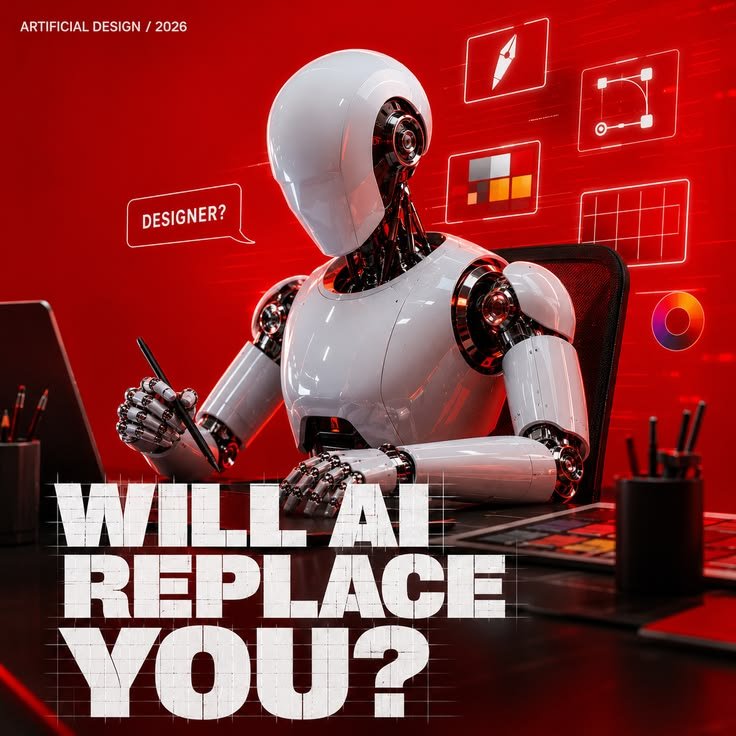
Generative AI has changed the way creative work is produced. From generating images and layouts to removing backgrounds, creating concepts and producing multiple design variations, AI graphic design tools can now complete tasks that once required significant manual effort.
This has led to an important question among students, aspiring designers and working professionals: Are AI tools replacing graphic designers?
The short answer is more nuanced than a simple yes or no.
AI is changing graphic design, but the biggest shift is not necessarily from “designers” to “AI.” It is from designers who rely mainly on manual execution to designers who can combine design fundamentals, creative thinking, problem-solving and AI tools to produce better work.
AI is changing the way designers work, but it is also changing which skills matter most. As more tasks become automated, creativity, design thinking, problem-solving, strategy and the ability to make the right creative decisions are becoming increasingly important.
So, what does this mean for the future of graphic design?
How AI Is Changing Graphic Design
AI has already become part of many modern creative workflows.
Today’s AI tools for graphic designers can help with tasks such as:
- Generating visual concepts from text prompts
- Creating images and illustrations
- Removing or replacing backgrounds
- Expanding images beyond their original dimensions
- Generating multiple design variations
- Creating colour palette suggestions
- Producing typography and layout ideas
- Editing and retouching images
- Creating social media content variations
- Automating repetitive production tasks
- Generating initial creative directions
Tools powered by generative AI can significantly reduce the time required for certain production tasks.
For example, a designer may previously have spent considerable time creating several visual directions manually. Today, AI can help generate initial concepts that the designer can review, modify and develop further.
This makes AI in graphic design less about simply producing an image and more about changing the workflow around that image.
Is AI Actually Replacing Graphic Designers?
There is a real shift happening in the design industry, and aspiring designers should pay attention to it. AI in graphic design is making many tasks faster and easier, from generating concepts and editing visuals to creating multiple design variations.
But there is an important distinction to understand.
AI can automate certain graphic design tasks, but that does not mean it can completely replace the role of a graphic designer.
A graphic designer’s work involves much more than creating pixels. A designer needs to understand:
- Who the target audience is
- What the business wants to communicate
- Why a particular visual direction works
- How the brand should be represented
- How typography, colour and layout support the message
- How different audiences may interpret the design
- How a design should adapt across different platforms
- How to respond to client feedback
- How to solve an unclear or complex creative problem
AI can assist with many parts of this process, but the designer still needs to make the creative decisions, evaluate the output and ensure that the final design serves its intended purpose.
This is why the more useful question may not simply be “Will AI replace graphic designers?”
A better question is:
“Which graphic design tasks can AI automate, and which skills will become more valuable as AI becomes part of the design workflow?”
AI vs Human Skills in Graphic Design
The difference between AI-generated output and professional design becomes clearer when we separate execution from decision-making.
AI can help with
Human designers add value through
Generating concepts
Understanding the actual problem
Creating visual variations
Selecting the right creative direction
Image generation
Building visual meaning
Background removal
Understanding context
Repetitive production
Creative decision-making
Quick iterations
Design strategy
Moodboard exploration
Brand understanding
Content variations
Audience understanding
Image editing
Critical evaluation
This does not mean AI cannot contribute to strategy or ideation. It increasingly can.
The point is that AI vs graphic designers is not necessarily a competition between two independent alternatives. In many workflows, the stronger model is human expertise supported by AI.
What AI Does Well in Graphic Design
AI has several advantages that make it extremely useful for designers.
1. Speed
AI can generate multiple ideas in a short period of time.
Instead of spending hours creating every variation from scratch, a designer can use AI to explore several directions quickly.
2. Ideation
Sometimes the hardest part of a project is getting started.
AI can provide references, visual directions, compositions and alternative concepts that designers can use as starting points.
The designer then decides which ideas are useful and how they should evolve.
3. Repetitive Tasks
One of the strongest applications of AI graphic design tools is automation.
Tasks that are repetitive or production-heavy can potentially be completed faster, allowing designers to spend more time on higher-value creative decisions.
4. Experimentation
AI makes it easier to explore unusual visual combinations.
A designer can test different styles, compositions, environments and visual concepts without manually creating every variation.
5. Productivity
AI can reduce the time spent on certain parts of the workflow.
This does not automatically make the final design better. It gives the designer more time to focus on the parts of the project where human judgment matters.
Where Human Graphic Designers Still Add Value
This is where AI vs human skills becomes particularly important.
Creativity Is More Than Generating Ideas
AI can generate thousands of visual possibilities.
But having thousands of possibilities does not automatically mean having the right idea.
A professional designer needs to understand:
What should we create? Why should we create it? And why will it work?
Creativity in design is closely connected to context, observation, experience and decision-making.
Design Strategy
A client does not usually hire a designer simply because they need an attractive image.
They may need to:
- Launch a product
- Build a brand identity
- Communicate a complicated idea
- Increase attention
- Create a consistent visual language
- Connect with a particular audience
- Improve the presentation of a product or service
This requires design strategy, not just visual generation.
Problem-Solving
Graphic design is fundamentally a problem-solving discipline.
For example, imagine a company says:
“Our social media looks inconsistent and doesn’t communicate our brand properly.”
The designer’s job is not simply to generate ten attractive posts.
The designer needs to identify the underlying problem and develop a visual system that solves it.
That involves hierarchy, typography, colour, composition, consistency and communication.
Critical Thinking
AI can produce an impressive image that is completely wrong for the project.
A designer needs to evaluate the output.
Questions such as these become important:
- Does this communicate the intended message?
- Is the visual appropriate for the audience?
- Does it fit the brand?
- Is the hierarchy clear?
- Does it work across different formats?
- Is the information accurate?
- Does the design solve the original problem?
This is why critical thinking for graphic designers becomes increasingly important in an AI-driven workflow.
The New Reality: Designers and AI Working Together
Instead of thinking about AI as a replacement for designers, it can be more useful to think about AI as another tool in the designer’s workflow.
Consider a typical project.
Traditional workflow
Brief → Research → Concept → Design → Revisions → Final Output
AI-assisted workflow
Brief → Research → AI-assisted ideation → Concept selection → Design development → Human refinement → Testing → Final Output
The difference is not necessarily that the designer disappears.
The designer’s role can shift toward direction, evaluation, strategy and refinement.
This is similar to how previous technologies changed design.
Software did not eliminate the need for designers. It changed how designers worked.
AI is accelerating that transformation.
What Skills Should Graphic Designers Develop in the AI Era?
If you are considering a graphic design career, learning software alone is no longer enough.
A future-ready designer needs a combination of technical, creative and strategic skills.
1. Design Fundamentals
Learn the principles behind good design.
This includes:
- Typography
- Colour theory
- Composition
- Visual hierarchy
- Grid systems
- Balance
- Contrast
- Spacing
- Branding principles
AI can generate a design, but understanding why a design works allows you to evaluate and improve it.
2. Creative Thinking
Creative thinking allows designers to move beyond obvious solutions.
Instead of asking:
“What can AI make?”
Ask:
“What should I make, and why?”
That change in thinking is important.
3. Problem-Solving
Learn how to convert a business or communication problem into a visual solution.
This is one of the most transferable graphic design skills because it remains relevant regardless of which software or AI tool becomes popular.
4. AI Literacy
Designers should understand how modern AI tools work and where they can fit into a creative workflow.
This can include learning:
- Generative image tools
- AI-assisted editing
- Prompting
- AI-powered ideation
- Automated design workflows
- AI-assisted research
- Image enhancement
- Content variation
The goal should not be to collect dozens of AI tools.
The goal is to understand when and why to use AI.
5. Visual Communication
A designer should be able to communicate an idea visually.
This means understanding the relationship between:
Message + Audience + Context + Visual Language
A technically impressive design can still fail if the message is unclear.
6. Portfolio Development
A strong portfolio should demonstrate more than polished visuals.
Show the thinking behind your work.
For example:
Problem → Research → Concept → Design Decisions → Final Solution
This allows employers and clients to understand how you approach creative problems.
7. Communication and Collaboration
Designers frequently work with clients, marketers, developers, copywriters, photographers and other creatives.
Being able to explain design decisions clearly is therefore an important professional skill.
What Does the Future of Graphic Design Look Like?
The future of graphic design is likely to involve greater collaboration between human creativity and AI-powered tools.
Some production-heavy tasks may become increasingly automated.
At the same time, designers who understand strategy, branding, communication, creative thinking and technology can potentially take on more sophisticated roles.
The World Economic Forum’s research supports the broader pattern: technological skills are growing in importance, while creative thinking, analytical thinking, resilience and adaptability also remain important.
This means the future designer may look different from the traditional designer.
Instead of being valued only for how quickly they can execute a design, designers may increasingly be valued for their ability to:
- Understand problems
- Develop creative concepts
- Direct AI tools
- Evaluate generated output
- Build visual systems
- Understand audiences
- Communicate ideas
- Make strategic design decisions
- Combine technology with creativity
Should You Still Learn Graphic Design in the Age of AI?
Yes, but the way you learn graphic design needs to evolve.
Learning only how to operate software can leave a designer vulnerable when technology changes.
Learning design fundamentals gives you a foundation that can be applied across tools.
For students and aspiring designers, the more future-ready approach is to develop three layers of capability:
Layer 1: Design Fundamentals
Learn how design works.
Layer 2: Practical Execution
Learn the tools and workflows used to turn ideas into professional outcomes.
Layer 3: AI + Strategic Thinking
Learn how to use AI to improve productivity while developing the judgment required to direct, evaluate and refine its output.
This combination is more valuable than simply knowing how to generate an AI image.
AI Will Change Graphic Design. Designers Need to Change Too.
The rise of AI does create real challenges for the design profession. Some tasks will become faster, cheaper or increasingly automated. The labour market evidence also indicates that certain design roles may face disruption as generative AI develops.
But disruption does not make design knowledge irrelevant.
It changes what professional value looks like.
The designer of the future may not be the person who can manually create every element from scratch.
They may be the person who can look at a problem, understand the audience, develop a strong concept, use the right technology, question the output and turn an idea into an effective visual solution.
So, are AI tools replacing graphic designers?
AI is replacing or accelerating some design tasks. It is also changing the skills employers may look for.
But the ability to think, communicate, solve problems and make meaningful creative decisions remains central to professional design.
The goal for aspiring designers should therefore not be to compete against AI.
It should be to learn how to design with AI without losing the human thinking that makes design valuable.
Frequently Asked Questions
Will AI replace graphic designers?
AI is expected to automate and accelerate many design tasks, particularly repetitive and production-oriented work. However, graphic design also involves strategy, communication, problem-solving, creative direction and judgment. The impact is therefore likely to vary by role, task and level of expertise.
Is graphic design still a good career in the age of AI?
Graphic design is changing because of AI, but design skills remain relevant across branding, advertising, digital media, social media, product communication and other creative fields. Aspiring designers can improve their long-term relevance by combining graphic design skills with AI literacy, creative thinking, strategy and strong portfolios.
What skills should graphic designers learn because of AI?
Important skills include design fundamentals, typography, colour theory, visual communication, creative thinking, problem-solving, critical thinking, branding, communication and AI literacy. Understanding how to evaluate and refine AI-generated output is also becoming increasingly useful.
Can AI create better designs than humans?
AI can create visually impressive designs quickly, but visual quality alone does not determine whether a design is effective. A professional design also needs to address its audience, purpose, brand context and communication objective. Human judgment remains important in evaluating whether an output actually solves the design problem.
How can graphic designers use AI without losing creativity?
Designers can use AI for research, brainstorming, visual exploration, repetitive tasks and variations while keeping the core creative decisions human-led. A useful approach is to treat AI as an assistant rather than allowing the tool to determine the entire creative direction.
Should students learn AI tools along with graphic design?
Yes. Students can benefit from learning both design fundamentals and AI tools for graphic designers. Understanding the principles of design gives students the ability to judge, improve and direct AI-generated work instead of simply accepting the first output.
What is the future of graphic design with AI?
The future of graphic design is likely to involve increased human-AI collaboration. Production workflows may become more automated, while skills such as creative thinking, analytical thinking, strategic design, communication and technological literacy become increasingly important.