

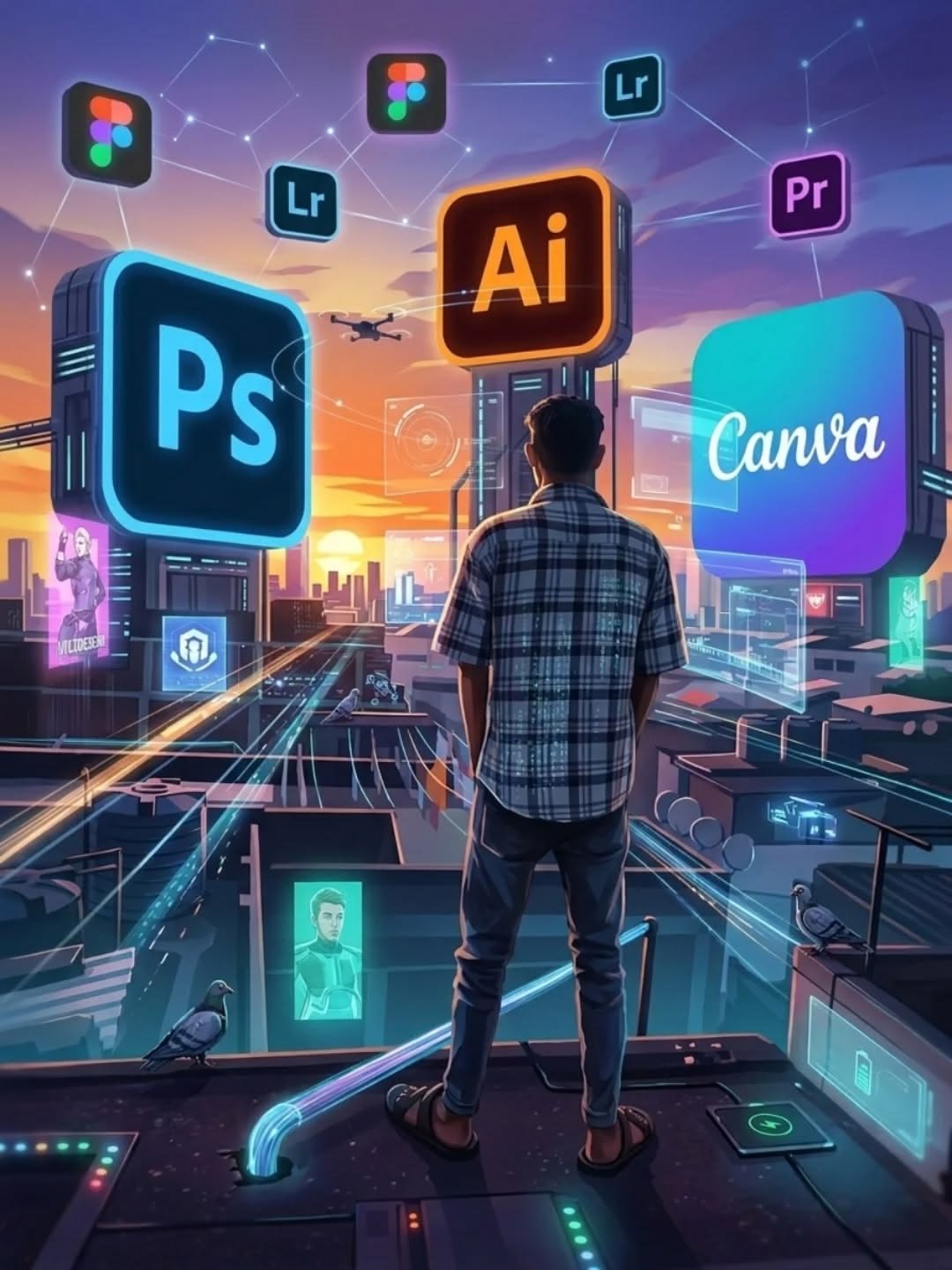
Knowing Adobe Photoshop, Adobe Illustrator, Figma or other graphic design software can help you execute creative ideas, but software knowledge alone does not define a professional designer.
So, what are recruiters looking for in graphic designers today?
The answer goes beyond software proficiency.
A strong designer needs a combination of design fundamentals, creative thinking, problem-solving skills, communication skills, visual communication, design thinking, AI literacy, adaptability, portfolio development and practical experience.
Whether you are a graphic design student, aspiring graphic designer, fresher, freelance designer or a professional looking to upgrade your skills, understanding what employers expect can help you build a more relevant graphic design career.
In this guide, we explore the most important skills for graphic designers and explain why they matter in today’s evolving creative industry.
What Skills Do Recruiters Look for in Graphic Designers?
Recruiters may look for different skills depending on the role, company and type of design work involved. A graphic designer job at a branding agency may require a different skill set from a role focused on social media design, advertising, UI design or motion graphics.
However, several core graphic designer skills are valuable across different creative roles.
These include:
- Graphic design fundamentals
- Typography
- Colour theory
- Composition
- Visual hierarchy
- Layout design
- Creative thinking
- Problem-solving
- Communication skills
- Visual communication
- Design thinking
- AI literacy
- AI tools for designers
- Software proficiency
- Portfolio development
- Attention to detail
- Adaptability
- Collaboration
- Time management
- Understanding design briefs
- Presentation skills
- Industry-relevant design skills
Let’s look at each of these skills required for graphic designers in more detail.
1. Strong Design Fundamentals
Before becoming an expert in design software, you need to understand the principles that make a design work.
Design fundamentals are the foundation of professional graphic design.
They include:
- Typography
- Colour theory
- Composition
- Visual hierarchy
- Balance
- Contrast
- Alignment
- Proximity
- Spacing
- Grid systems
- Scale and proportion
These principles apply whether you are designing a poster, logo, social media creative, presentation, advertisement, packaging or digital interface.
For example, a designer might know every feature in Photoshop but still create a weak poster if the typography is difficult to read or the visual hierarchy does not guide the viewer toward the most important information.
This is why design fundamentals for graphic designers are often more important than simply knowing more software features.
Why are design fundamentals important?
Because software helps you execute a design, while fundamentals help you decide what the design should look like and why.
A designer with strong fundamentals can adapt to different tools because the underlying principles remain relevant.
2. Typography Skills
Typography is much more than selecting an attractive font.
Typography in graphic design involves understanding how type communicates information and creates visual structure.
Recruiters and creative teams may expect designers to understand:
- Font selection
- Font pairing
- Font hierarchy
- Letter spacing
- Line spacing
- Text alignment
- Readability
- Legibility
- Type scale
- Display versus body typography
Imagine designing a promotional poster.
If the headline, supporting information and call-to-action all have the same visual importance, the viewer may not know where to look first.
Effective typography skills help solve that problem.
3. Understanding Colour Theory
Colour can influence attention, hierarchy, mood and brand perception.
A designer should understand colour theory in graphic design, including:
- Primary, secondary and tertiary colours
- Complementary colours
- Analogous colours
- Colour harmony
- Contrast
- Saturation
- Warm and cool colours
- Brand colour systems
However, choosing colours should not be based only on personal preference.
A professional designer needs to consider the brand identity, target audience, communication objective and context.
For example, the colour approach for a children’s education campaign may differ significantly from that of a financial services brand.
4. Composition and Visual Hierarchy
Good design helps viewers understand information quickly.
This is where composition in graphic design and visual hierarchy become important.
Visual hierarchy determines how the viewer’s attention moves through a design.
A designer can create hierarchy through:
- Size
- Scale
- Colour
- Contrast
- Position
- Typography
- Spacing
- Shape
- White space
A strong composition ensures that different elements work together rather than competing for attention.
These are essential graphic design skills for everything from social media graphics to advertising campaigns and brand communication.
5. Creative Thinking
Creativity is one of the most important skills for graphic designers, but professional creativity is not simply about making something unusual.
A professional designer needs to generate ideas that are:
- Relevant
- Original
- Practical
- Appropriate for the audience
- Aligned with the brief
- Connected to the communication objective
For example, a designer working on a product launch may need to develop several campaign concepts while maintaining the brand’s visual identity.
This requires creative thinking in graphic design, not just technical execution.
6. Problem-Solving Skills
At its core, graphic design is visual problem-solving.
A client may say:
“Our campaign isn’t getting enough attention.”
The designer’s job is not simply to make another attractive graphic.
The designer needs to understand:
- What is the communication problem?
- Who is the audience?
- What information matters?
- What is stopping the audience from understanding the message?
- What visual approach could improve communication?
This is why problem-solving skills for designers are highly valuable.
A good designer does not simply ask:
“What should I make?”
They ask:
“What problem am I trying to solve?”
7. Ability to Understand a Design Brief
Professional designers usually work within specific requirements.
A design brief may include:
- Project objectives
- Target audience
- Brand guidelines
- Deliverables
- Content requirements
- Platform
- Dimensions
- Timeline
- Budget
- Communication goals
A designer needs to interpret this information before beginning the visual execution.
The ability to understand a design brief demonstrates that you can work with real-world requirements rather than designing purely according to personal preferences.
This is an important part of becoming an industry-ready graphic designer.
8. Communication Skills for Designers
Designers communicate visually, but they also need strong verbal and written communication skills.
You may need to explain:
- Why you selected a particular concept
- Why a specific colour palette was used
- How the design addresses the brief
- Why a particular layout works
- What problem the design solves
- Why one design direction is more appropriate than another
Being able to explain design decisions clearly is an important professional skill.
You do not need complicated design terminology.
You need to communicate your thinking in a way that clients, managers and team members can understand.
9. Visual Communication Skills
The purpose of graphic design is ultimately communication.
A design should help the audience understand something.
Visual communication skills involve using images, typography, colour, layout, symbols and other visual elements to communicate information effectively.
For example, an advertisement may need to communicate:
Product + Benefit + Offer + Call to Action
If the viewer cannot understand these elements quickly, the design may not be doing its job effectively.
This is why visual communication in graphic design is such an important skill.
10. Design Thinking
Design thinking encourages designers to understand the problem and the people affected by it before jumping into execution.
A simple design-thinking approach can involve:
Understand → Research → Define → Ideate → Prototype → Test → Improve
For a digital product, for example, a designer may need to understand what users struggle with before designing a new interface.
Design thinking can help designers move from:
“How can I make this look better?”
to:
“How can I make this work better for the intended audience?”
That change in mindset is valuable across branding, advertising, digital design and UI/UX.
11. AI Skills for Graphic Designers
AI is becoming part of many creative workflows.
This means AI skills for graphic designers are becoming increasingly relevant.
Modern designers may encounter AI tools for:
- Image generation
- Concept development
- Brainstorming
- Moodboards
- Image editing
- Content ideation
- Research
- Background removal
- Creative variations
- Workflow automation
However, learning AI does not mean abandoning fundamental design skills.
A designer still needs to evaluate whether an AI-generated result is:
- Visually effective
- On-brand
- Technically usable
- Relevant to the audience
- Consistent with the brief
AI and big data and technological literacy among skill areas expected to grow in importance, alongside creative thinking and lifelong learning.
Therefore, AI literacy for designers should be viewed as an additional capability rather than a replacement for design judgment.
12. Knowledge of AI Tools for Designers
There is an important difference between knowing that AI exists and knowing how to incorporate AI into a professional workflow.
A designer can experiment with AI tools for designers for:
Research → Ideation → Exploration → Production → Refinement
For example, AI can help generate several early creative directions. The designer can then select, modify and refine the direction that best addresses the brief.
The important skill is not simply generating an image.
It is knowing when to use AI, how to use it and how to evaluate its output.
13. Software Proficiency
Software knowledge still matters.
Depending on the role, designers may work with tools such as:
- Adobe Photoshop
- Adobe Illustrator
- Adobe InDesign
- Figma
- After Effects
- Premiere Pro
- Other digital and AI-assisted creative tools
The exact tools required depend on the job.
A branding designer may need strong Illustrator skills.
A social media designer may frequently work with Photoshop and other content-creation tools.
A UI/UX designer may need Figma.
A motion designer may work extensively with After Effects and Premiere Pro.
The important point is to connect software skills with design knowledge.
14. Portfolio Development
A resume can tell recruiters what you have learned.
A graphic design portfolio can show them what you can actually create.
This makes portfolio development for graphic designers an important part of career preparation.
Your portfolio should ideally demonstrate:
- Design fundamentals
- Creative thinking
- Problem-solving
- Typography
- Colour
- Composition
- Branding
- Digital design
- Software proficiency
- Understanding of briefs
Instead of uploading dozens of unrelated designs, focus on presenting selected projects properly.
For each project, consider showing:
Brief → Problem → Research → Concept → Design Process → Final Design
This gives recruiters more insight into your design process.
15. Creating a Portfolio Without Professional Experience
One common concern among freshers is:
“How can I create a portfolio if I haven’t worked for a company yet?”
You can create self-initiated projects based on realistic briefs.
For example:
- Create a brand identity for a fictional café
- Design a social media campaign for a startup
- Develop packaging for a hypothetical product
- Redesign an existing visual communication piece as a learning exercise
- Create an advertising campaign for a fictional brand
The key is to demonstrate your design thinking, creative process and problem-solving ability, rather than simply filling your portfolio with random artwork.
16. Adaptability and Willingness to Learn
The design industry continues to change.
New software, AI tools, platforms, formats and workflows appear regularly.
Therefore, adaptability for graphic designers is an important career skill.
A designer should be willing to:
- Learn new tools
- Experiment with new workflows
- Understand emerging technologies
- Accept feedback
- Improve existing skills
- Explore different design disciplines
The ability to keep learning is particularly valuable for students and professionals building a long-term graphic design career.
17. Attention to Detail
Professional design often depends on small details.
A designer needs to check:
- Alignment
- Spacing
- Typography
- Colour consistency
- Image quality
- File formats
- Brand guidelines
- Dimensions
- Export settings
Strong attention to detail in graphic design can make the difference between a rough design and a polished professional deliverable.
18. Collaboration and Teamwork
Graphic designers rarely work completely alone.
Depending on the organization, you may collaborate with:
- Copywriters
- Marketing teams
- Creative directors
- Developers
- Photographers
- Video editors
- Social media managers
- Product teams
- Clients
Therefore, teamwork skills for designers can be just as important as technical skills.
Being able to receive feedback, discuss ideas and work toward a shared objective is part of professional design work.
19. Time Management
Creative work still has deadlines.
A designer may have to deliver:
- Social media posts by the end of the day
- Campaign assets within a week
- Multiple design variations
- Presentation decks before a meeting
- Brand assets according to a launch schedule
Good time management for graphic designers helps maintain both quality and productivity.
The goal is not simply to work faster.
It is to understand priorities, organize tasks and deliver work within the required timeline.
20. Understanding Industry Requirements
A professional designer needs to understand that every design has a purpose and production context.
For example, creating a social media graphic is different from creating:
- A print advertisement
- Packaging artwork
- A logo system
- A presentation
- A website design
- A mobile app interface
- A motion graphic
Understanding formats, dimensions, file preparation, brand guidelines and platform requirements contributes to industry-ready design skills.
What Are the Most Important Skills for a Graphic Design Career?
There is no single skill that guarantees success in graphic design.
Instead, think of your skill set as a combination:
Graphic Design Skill
Why It Matters
Design fundamentals
Creates a strong visual foundation
Typography
Improves readability and hierarchy
Colour theory
Supports communication and visual consistency
Composition
Creates balanced and effective layouts
Creative thinking
Helps generate relevant concepts
Problem-solving
Helps address real communication challenges
Communication skills
Helps explain and present ideas
Design thinking
Keeps the problem and audience in focus
AI literacy
Helps adapt to evolving creative workflows
Software skills
Enables professional execution
Portfolio development
Demonstrates practical ability
Adaptability
Supports continuous learning
Attention to detail
Improves professional quality
Collaboration
Supports effective teamwork
Time management
Helps meet professional deadlines
These skills should not be treated as separate boxes to tick.
They work together.
Software + Fundamentals help you execute.
Creativity + Problem-Solving help you generate solutions.
Communication + Design Thinking help you explain and justify those solutions.
AI Literacy + Adaptability help you navigate changing workflows.
Portfolio Development helps demonstrate what you can actually do.
What Should Beginner Graphic Designers Learn First?
If you are beginning your graphic design career, you do not need to master every tool immediately.
A practical learning path can look like this:
Step 1: Learn Design Fundamentals
Start with:
- Typography
- Colour theory
- Composition
- Layout
- Visual hierarchy
- Spacing
- Grid systems
Step 2: Learn Graphic Design Software
Build practical proficiency in relevant tools such as Photoshop, Illustrator or Figma depending on your career direction.
Step 3: Practise With Realistic Design Briefs
Create projects based on realistic business and communication problems.
Step 4: Develop Problem-Solving Skills
Ask why a particular design solution works rather than simply whether it looks attractive.
Step 5: Learn AI-Assisted Design Workflows
Explore AI tools for graphic designers and understand how they can support ideation and production.
Step 6: Build a Graphic Design Portfolio
Document selected projects and explain your creative process.
Step 7: Practise Communication
Learn to present your work and explain your design decisions confidently and clearly.
How Can Students Become Industry-Ready Graphic Designers?
For students and freshers, the biggest challenge is often moving from learning software to applying those skills to realistic projects.
Structured design education can help bridge that gap by combining design fundamentals, software training, practical projects, portfolio development and professional guidance.
At Yogi Arts Design School (YADS), students can work on practical design projects while developing their understanding of design principles and building a portfolio.
The objective of learning graphic design should not simply be to complete software tutorials.
It should be to develop the ability to think, create, solve visual problems and communicate ideas effectively.
That broader approach can help students prepare for different areas of the creative industry.
Is Photoshop Enough to Become a Graphic Designer?
No, Photoshop alone is not enough to become a well-rounded graphic designer.
Photoshop is an important graphic design software tool, but professional design also requires:
- Design fundamentals
- Typography
- Colour theory
- Composition
- Visual hierarchy
- Creative thinking
- Problem-solving
- Communication
- Design thinking
- AI literacy
- Portfolio development
Think of Photoshop as a tool.
Your design knowledge is what tells you how and why to use it.
Frequently Asked Questions About Graphic Designer Skills
What skills do recruiters look for in graphic designers?
Recruiters may look for a combination of graphic design skills, including design fundamentals, software proficiency, typography, colour theory, composition, creative thinking, problem-solving, communication, AI literacy, adaptability and portfolio quality. Requirements vary according to the role and organization.
What are the most important skills for a graphic designer?
Important skills for graphic designers include design fundamentals, creative thinking, problem-solving, visual communication, typography, colour theory, composition, software proficiency, communication skills, AI literacy and portfolio development.
Is Photoshop enough to become a graphic designer?
No. Photoshop is one tool within a larger graphic design skill set. Designers also need to understand visual communication, typography, colour, composition, creative problem-solving and design principles.
What skills should a beginner graphic designer learn?
A beginner should start with design fundamentals, including typography, colour theory, composition, layout and visual hierarchy. After that, they can develop software proficiency, practise through projects, learn AI-assisted workflows and build a graphic design portfolio.
Why is a portfolio important for graphic designers?
A graphic design portfolio gives recruiters practical evidence of your abilities. It can demonstrate your design process, creative thinking, problem-solving, software skills and ability to respond to realistic design briefs.
Are AI skills important for graphic designers?
AI literacy is becoming an increasingly relevant skill for designers. AI tools can support ideation, research, image generation, editing and workflow efficiency. However, designers still need human judgment, design fundamentals and creative problem-solving to evaluate and refine the output.
What is design thinking in graphic design?
Design thinking is a problem-focused approach that encourages designers to understand the audience, define the problem, explore ideas, test solutions and improve the final result. It helps designers focus on solving communication problems rather than simply creating visually attractive work.
How can freshers build graphic design skills?
Freshers can build graphic design skills through structured learning, practical projects, self-initiated briefs, feedback, portfolio development and regular practice. Working on realistic projects can help connect theoretical knowledge with practical application.
What should a graphic design portfolio include?
A strong graphic design portfolio can include branding projects, social media designs, advertising concepts, typography projects, digital designs and other relevant work. More importantly, it should demonstrate the problem, design approach, creative process and final solution.
Final Takeaway: Build Skills Beyond Software
The modern designer needs more than a list of software on a resume.
Photoshop is a tool. Illustrator is a tool. Figma is a tool. AI is a tool.
What matters is how effectively you use those tools to solve problems and communicate ideas.
If you are building a graphic design career, focus on developing a complete skill set:
Design Fundamentals + Typography + Colour Theory + Composition + Visual Communication + Creative Thinking + Problem-Solving + Communication + Design Thinking + AI Literacy + Software Skills + Adaptability + Portfolio Development
For students, freshers and working professionals, the goal should not be to learn every tool available.
The goal should be to become a designer who can understand a brief, identify a problem, develop a creative solution, explain the design decisions and deliver professional-quality work.
That combination of technical skills, design knowledge, creative thinking, problem-solving, communication, AI literacy and practical experience can help you build a stronger foundation for a modern graphic design career.